|
|
|
Leather is a resilient natural substance but is quite sensitive. Leather clothes are renowned for its robust and supple dynamics and forever set the fashion world on fire with enticing layouts and styles. However leather dresses must be stored properly and cleaned with a professional approach.
Leather clothes needs to be properly dealt with and put away in order to retain it for years. They need to be hung on hangers to ensure that their appearance is held on to. The same goes for stashing them under direct sunlight.
Never apply perfume or any aerosols on leather as it can damage its texture. In case your leather outfit gets moist, it should be dried out naturally. Its elasticity can be restored by a moisturizer. The cleaner used to clean any leather clothing should allow the leather's natural lubricating oils to stay. Apart from this it shouldn't leave a slimy deposit as any kind of residue or deposit will entice bacterial growth that may deteriorate your leather. Conditioners for leather are usually helpful to lubricate it and thereby rejuvenate the bend ability of the leather. To protect the leather from water or other fluids moisture barriers are useful. Leather products are natural and hence exquisite and have its own feel along with its own blemishes. To enhance the life of the leather proper and smart care is required.
|
|
|
|
 |
 |
Cleaning leather hardly requires a professional touch and if done so most of them loses their dye, at least partly. Mending the color of the outfits is a part of the cleaning practice. Purchase of light leather shades must be avoided as some leather tints are hard to match. For that reason, it's vital to ensure your cleaner understands his or her job. The mark of a good cleaner is that they forewarn you about the color fade that may happen.
|
|
|
|
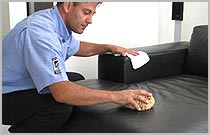
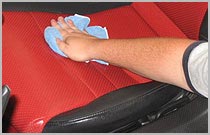
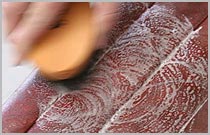
Leather apparels can be self cleaned most of the times. Smooth finish leather is usually wiped using a moist fabric (preferably a sponge) to shed the debris. For more adamant stains a mild soap and water could be used. It really is a sound technique prior to dampening the leather to test it’s inside seam to check if the leather has a finish (water will bead on finished leather). In case a suede leather jacket or blazer gets a spot, make use of a suede scrub brush or very fine sand paper. |
 |
|
|
|
 |
Seal the leather pores with baby powder while fine dusting and give it a rubdown finish to get its sheen back. A wrinkled garment can be mildly ironed but don't forget to place a piece of paper between the garment and the iron. A leather garment need not be locked away in a vault but the place it is stored needs a good air circulation, also cover it a cloth or paper but avoid plastic. Like humans even leather garments need their breathing space. |
|
|
|
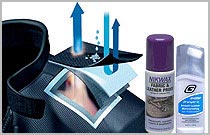
Spraying silicone or using mink oil can help you waterproof any of your leather outfit. But on the flip side this approach is likely to darken the leather apparel. The best approach would be to test it on a small area, preferably on the inside. If your untreated leather garment gets accidentally wet, allow it to dry on a flat surface far from any heat source preferably at room temperature. Give it a night’s time to dry completely. Always bear in mind that too much heat can rob the leather of its essential oils resulting in a hard and cracked outfit, so excess heat is a big no to dry leather. The best way to get it dry is to use wooden hangers and of course away from the heat.
|
 |
|
|
|
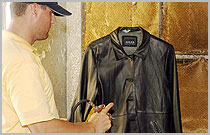 |
As mentioned above it needs to be hung in a cool dry place (away from heat) and shielded with a cloth or even paper. Make sure it has enough air circulation. Avoid any proximity with moth balls or plastic.
|
|
|
|
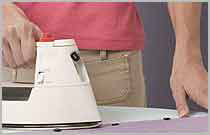
Removing wrinkles from any leather apparel is a tricky business and needs to be carried out with utmost care. A mildly hot iron can be used but not directly on the leather outfit, rather place a piece of paper or cloth (preferably 100% cotton cloth) between them. Never leave the iron on the clothing for too long. In case of slight wrinkles a blow dryer can be made use of, but again not directly. While trying to get rid of wrinkles from a leather jacket always remember 2 things: patience and caution.
|
 |
|